
The Wild Muş Tulip of Turkey
After photographing wild tulips in Kyrgyzstan last year, I came home with a quiet addiction. There is something about seeing tulips the way nature intended: so small and wild in their vast landscapes. So when the chance came up to photograph wild tulips in the east of Turkey via my friends at the World Tulip Society, I didn’t think twice. I went there with a team of Chinese that were working on a documentary.
The flower I came for is locally known as the Muş lalesi - the Muş tulip - and it grows in largue quantities on the plains surrounding the city of Muş in eastern Anatolia. Muş itself isn’t large (around 120,000 people), and it sits tucked between mountain ranges in a region most travelers fly straight over. Thanks to Turkish Airlines, who flew me out from Amsterdam, I was there in a matter of hours.

Beautiful light on the plains.
A welcome in Muş
I was met in town by a local photographer named Adem Kapan, who has been documenting the Muş tulip for years. His prints hang in restaurants and hotels around town, and walking through the streets with him felt a little like walking with a local celebrity. Everyone seemed to know him. He proudly showed me his studio and his archive, and that hospitality set the tone for the whole trip. Muş is a quiet, easy place. The food is excellent (the döner alone is worth the trip), and there is none of the rush of bigger Turkish cities.

A flower with a longer history than you think
It is easy to forget, especially if you grew up in the Netherlands, as I did, that the tulip is not a Dutch flower. It is an Anatolian and Central Asian one. Wild tulips like the ones around Muş were already growing here long before the Ottomans cultivated them in palace gardens in Istanbul, and centuries before bulbs were carried to Vienna and then on to Leiden in the late 1500s, where they ignited “tulipmania” and the flower industry the Netherlands is still famous for today.
In other words: the tidy red tulips lining Dutch supermarket shelves every spring trace their lineage back to flowers very much like these. Standing in a field of them feels a bit like meeting an ancestor.
A short drive out of the city, we already saw the first tulips. What surprised me was the density. In Kyrgyzstan, the wild tulips grow in dramatic settings but in smaller clusters; you have to hunt for them. Here on the Muş plain, they grow in carpets. Whole hillsides flush red.


Diversity
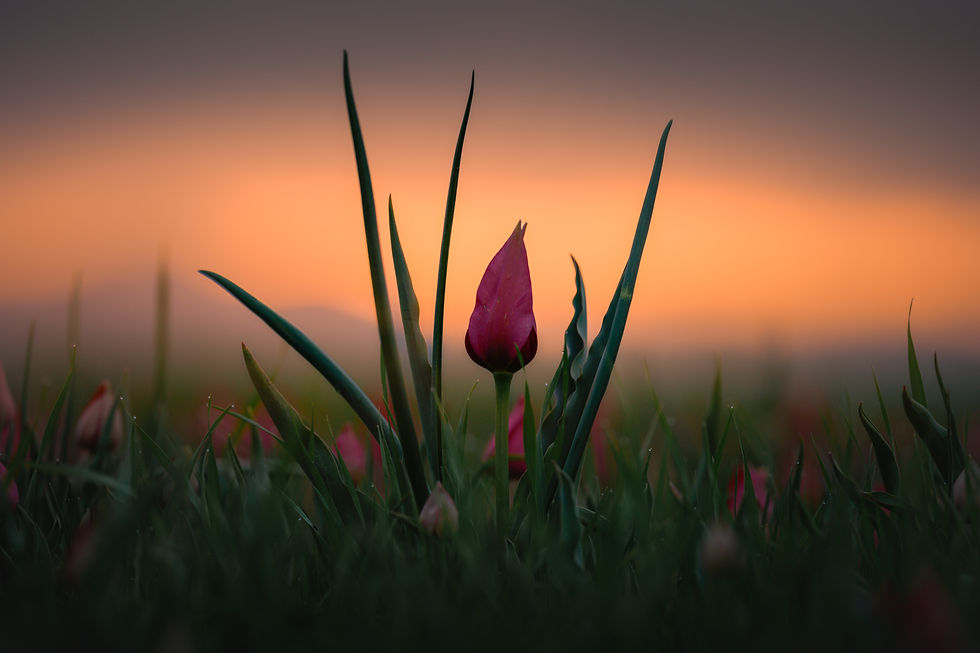
When you photograph the same flower for several days in a row, you start to read its behaviour. Over my three days in Muş the weather did everything: thunderstorms rolling down off the mountains, cold mornings with the grass silvered in dew, blue afternoons with hard light, and dramatic evening skies. The tulips reacted to all of it. During the storms they closed up tight. We learned to be out early every morning, watching them open as the first sun touched the plain. It is a small, slow, beautiful thing to witness.

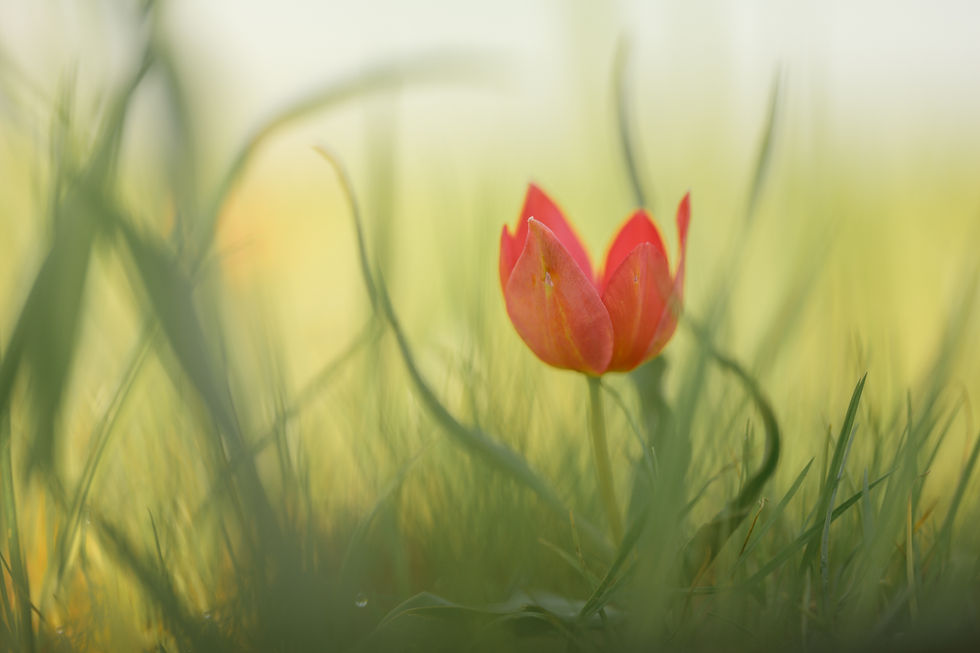

Up close, there was a whole different world. Tiny grasshoppers, springtails, beetles, the occasional bee : the flowers were busy. In the mornings the petals carried huge drops of dew that bent the light in odd ways, which I captured with my macro lens.
I tried to photograph the Muş tulip from every angle I could think of: the wide landscape, the intimate close-up, the insects living inside the bloom, the flower closed against the wind, and the flower fully open, with its loose, slightly unkempt shape when the sun finally hits it. It has none of the prim symmetry of a cultivated tulip. It looks a bit wild and a bit windblown, which is exactly what it is.


Three days
Three days is not a lot, but I think I came home with a real body of work: wide, intimate, atmospheric, all of it. What surprised me almost as much as the flowers was the reaction of the people in Muş. For them, the tulip is just there every spring; it is part of the place, like the mountains. The idea that someone would fly in from another country specifically to photograph it was genuinely new to them. Local journalists came out to do interviews, and at one point the mayor asked to meet us. He thanked us, sincerely, for showing the world what grows on his doorstep.
Local news footage


What’s next
Visiting Muş was one of those trips where the place quietly outperforms the assignment. The culture, the warmth of the people, the food, and of course the flower itself, all of it stayed with me. And I left already planning to come back. The plains are only part of the story: the same tulip also grows higher up in the mountains, right next to the lingering glaciers, blooming later in the season. That is the next chapter I want to photograph.
Can’t wait to be back!
Behind the scenes
A few frames from the three days on the plain, all phone snaps from Adem.
Albert Dros · Photographed in Muş, Eastern Turkey · April 2026
